Fused Silica
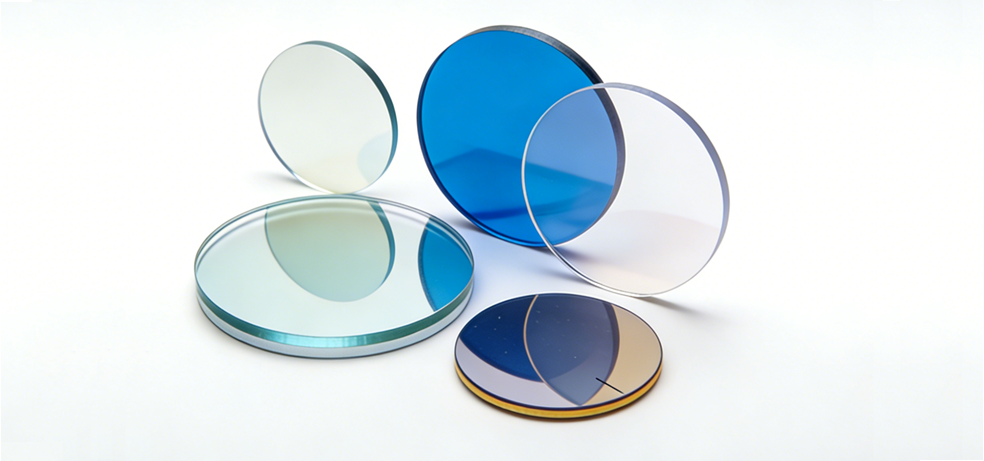
Thanks to their exceptional properties, fused silica wafers are highly valuable in a wide range of optical applications. These wafers are available in various grades, each tailored for specific uses such as deep‑ultraviolet (DUV) and infrared (IR) applications.
UV‑Grade Fused Silica
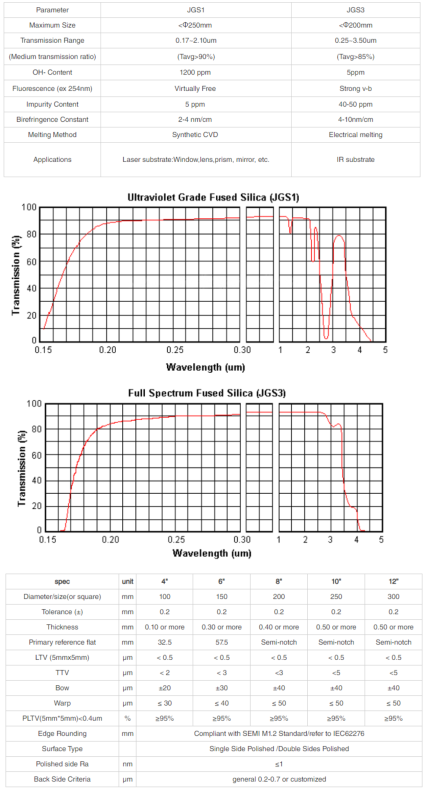
UV‑grade fused silica wafers are made from fully synthetic material with extremely low trace metal content, produced using a synthetic chemical vapor deposition (CVD) process. This method ensures high purity and excellent optical performance. Fused silica features strong thermal resistance and a broad transmission range, with transmittance exceeding 85% at 185 nm and over 90% from 200 nm to 2000 nm. Common brands and grades of UV‑grade fused silica include JGS1, Corning 7980, and OHARA SK1300.
ACA offers these wafers in diameters up to 8 inches (200 mm) with a surface roughness (Ra) of less than 0.5 nm, making them ideal for precision optical applications where minimal surface defects are critical.
IR‑Grade Fused Silica
IR‑grade fused silica wafers are specifically designed for applications requiring high transmission in the infrared range, typically from 185 nm to 3500 nm. These wafers feature an extremely low hydroxyl (OH) content, generally below 5 ppm, which minimizes absorption in the infrared region. Electric fusion is employed to produce IR‑grade fused silica, ensuring high purity and consistency. Popular brands and grades of IR‑grade fused silica include JGS3, Corning 7979, and OHARA SK1310.
ACA provides these wafers in diameters up to 8 inches (200 mm) with a surface roughness (Ra) of less than 0.5 nm, suitable for high‑precision infrared optical components and applications where low OH content is essential to performance.